
Developer Okomotive • Publisher Panic • Release August 21 • Played On PC
Herdling is an incredibly simple game with a sharp focus. Games with a small scope can often run the risk of being too thin for their own good, too focused on a single idea that never gets to evolve, but Herdling walks that fine line elegantly. There’s no doubt that the game’s simplicity can leave you feeling a little hungry for more at times. Still, the moments when Herdling eases off from its puzzles and lets you sit in the emotions, sights, and sounds of its larger environments and titular herd were when things came together the most.

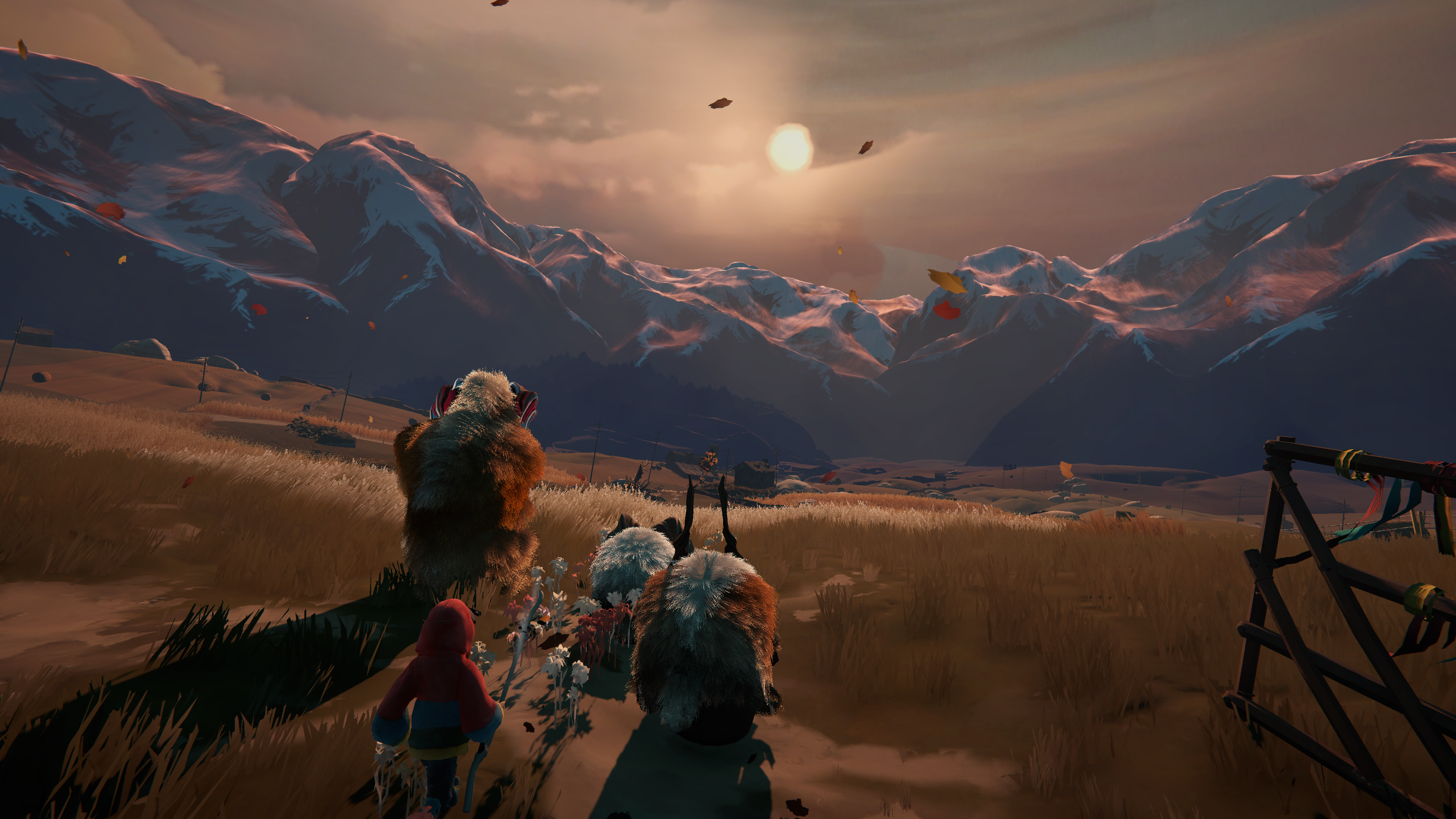
Herdling is a game about guiding a pack of Calicorns (a mythical-seeming animal reminiscent of goats mixed with sheep) across the wilderness while keeping them out of harm’s way from predators and making sure they’re well-groomed and fed. While accurate, that description feels a bit like a misrepresentation of what Herdling is actually about. Yes, there are hazards you need to guide your herd through, yes, there are predators to look out for, but the vast majority of my time with Herdling was spent traversing large open fields, navigating cozy forests, and riding ferries across sprawling rivers with my Calicorns.
Those moments between setpieces, however, are accompanied by a gorgeous score of classical music and lifelike sound effects coming from your Calicorns as they trudge their way through beautiful fields, pushing closer and closer to the mountains in the distance. Herdling is a quiet game that feels intentionally reflective, meant to make you think about simple moments in life when accompanied by livestock or other pets. It forced me to pause and think about my own life and the kinship I’ve felt with animals I’ve traveled with, pets I’ve bonded with in quiet moments while experiencing the joy of simply being in nature.

Despite the lack of dialogue or any more traditional storytelling, I found Herdling to be a deceptively emotional game. The incredible score gives the entire thing a vibe akin to something like an animated Pixar short, a silent film meant to portray the feeling of a moment instead of the precise particulars of its context.
That’s not to say there’s no drama in the game; it just doesn’t come from the places games normally derive it from. For example, as I started accumulating Calicorns to join my herd, I assumed that they were scripted encounters necessary to continue with the main path of the game. When hiding from a terrifying giant owl, however, the predator swooped down and killed one of my Calicorns in a non-scripted event. It was my lack of care that needlessly resulted in the death of one of my herd. I felt genuinely awful about it, like I had an abrupt wakeup call that I wasn’t doing my job correctly, as if I had let a real creature die.
The magic of Herdling comes from your connection to your Calicorns. Usually, a Calicorn joins your herd after you save it from something that was endangering its life. The game plays on a very human part of the psyche; no one wants to watch an animal suffer, so you’d better give it a hand before it gets too hurt. When a Calicorn joins your herd, you give it an individual name — you feel bonded with it. This means that allowing even a single Calicorn to be taken down feels like a devastating failure. Herdling doesn’t punish you in any material way, but it’s the emotions you’ve channeled for your herd that deal the real damage.

Herdling can be a little frustrating to play at times when solving puzzles, as your herd gets so big that navigating small environments becomes a bit of a hassle. However, at its core, the game isn’t actually about puzzle solving or anything like that. It’s about the bond we have with nature and understanding that in life, sometimes things don’t go according to plan.
There’s something about Herdling that was hard to put my finger on as I’ve thought it over. It’s not an outwardly emotional game — there’s nothing particularly complicated about its mechanics — but it has a heart to it that’s difficult to deny. It’s compelling in a quiet, subtle way that might not be immediately apparent, but as you push out of the city and closer to the distant mountains, it’s almost like you can actually smell the fresh air and hear the sound of the grass rustling in the wind as you guide your herd.

Leave a Reply